
Skip to content

The Artists Who Are Making People Look at Plastic Differently

Data tells people what plastic circularity challenges look like at scale. Art makes them feel it on a human level. The statistics on plastic pollution are better documented than ever, but information alone has never been sufficient to change behavior. People need something to land on emotionally before they can be compelled to act.

Artists working with plastic understand this, and their work has become one of the most effective complements to the science and policy arguments that dominate the conversation.
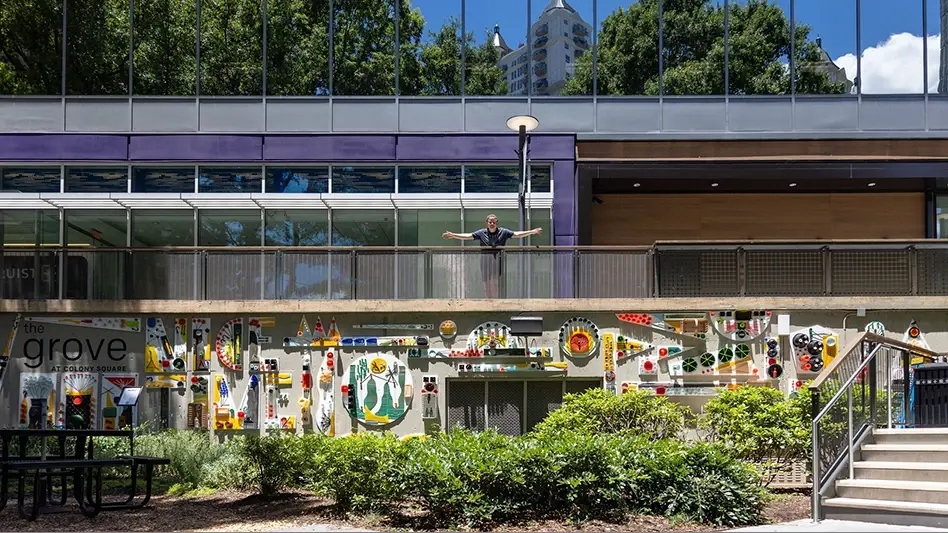
Hyland Mather's

Plastic Has Always Belonged in Art

The story of plastic as an artistic medium is longer than most people realize. According to the Metropolitan Museum of Art, plastic was developed in the mid-nineteenth century for commercial purposes, but it was first adopted into art in the twentieth-century. Abstract Expressionists used synthetic enamel paints for their fluidity and intensity. Pop Artists were drawn to plastic’s mass-produced associations. Sculptors appreciated the transparency and lightness of acrylic sheet and resin that traditional materials couldn’t offer.

Plastic earned its place in art for the same reasons it earned its place in manufacturing. It was versatile and capable of doing things no other material could. Plastic has long been established as a legitimate medium with aesthetic history independent of environmental concerns.

Art That Changes the Way People See

Today, plastic is often used in art to send a message. A data point about plastic pollution can be read and forgotten. A physical installation made from that same plastic, displayed in a public space people walk through every day, is harder to dismiss. This is what gives contemporary plastic art its particular cultural power.

Brazilian artist Vik Muniz has spent decades building elaborate, large-scale portraits and compositions from discarded materials, including plastic waste, that are photographed and exhibited as final works. Recycling International has described his practice as proof of the true power of trash. The act of transforming waste into something beautiful forces audiences to confront the material itself.

Aurora Robson, founder of Project Vortex, has spent over two decades intercepting the plastic waste stream to create large-scale sculptures and installations. In an interview with Artnet News, Robson described her practice as a way of helping people see things they might not otherwise see. She pursues this goal through works that are deliberately beautiful, removing the visual barrier of ugliness that typically keeps audiences from engaging with waste. Project Vortex has grown into an international collective of artists and designers, each working from the same premise that art can move people on the subject of plastic pollution in ways that advocacy can’t.

Then there’s Xin Liu, whose work pushes the idea further still. Rice Magazine reported on Liu’s 2025 installation “The Permanent and the Insatiable” at Rice University’s Moody Center for the Arts. It's a sculpture built from polyethylene terephthalate (PET) plastic representing the Houston skyline, submerged in liquid enzymes designed to break it down over the course of the exhibition. The piece, created in collaboration with microbiologist Erika Erickson, staged a live contest between plastic’s engineered durability and biology’s capacity to decompose it. The audience watched the material change over the course of weeks, making plastic's permanence physically visible in real time

Why Public Art Works Differently

While gallery installations reach people who seek them out, public art reaches everyone else. The park visitor or the office worker cutting through a plaza haven’t opted into an environmental message. The work has to be compelling enough to earn their attention.

This is why scale matters so much in plastic art. A monumental installation commands the kind of attention that a wall placard never could, and it does so without requiring anything of the viewer beyond presence. The encounter happens in ordinary life, inside the same spaces where plastic itself is used and discarded every day.

Nice Time: ALPLA Joins the Conversation

In the summer of 2024, ALPLA brought this tradition to Midtown Atlanta. Working with artist Hyland Mather, who’s known for large-scale assemblage works made from found and discarded objects, the company commissioned “Nice Time,” a three-dimensional installation displayed in The Grove, a pocket park located at the mixed-use Colony Square development.

The piece was created entirely with plastics discovered by Mather throughout the Atlanta area, as well as plastics collected by ALPLA employees. Mather built it over the course of a week on-site, for members of the public to observe, before its formal unveiling on June 7. The installation remained on view throughout the summer.

The title came from a phrase Mather landed on while thinking about the contradictions of the moment. He described “Nice Time” as being about the time we live in, acknowledging the genuinely difficult obstacles ahead while insisting that humans are remarkable and that we still live on a magnificent planet in an awe-inspiring time. The phrase carries both gratitude and urgency without falling into either sentimentality or despair.

During the project, Mather toured an ALPLA plastics facility in Georgia and visited the Center for Hard to Recycle Materials, which he said deepened his understanding of plastic production and the complexities involved in how plastic moves through the world.

For ALPLA, the installation was an extension of the Plastic Reimagined initiative, a public-facing commitment to making the case for plastic's continuing value when it remains in circulation. ALPLA Sustainability shared that the work embodied the hope that people would reimagine all the possibilities for plastics and drive action toward sustainability.

That’s the emotive power of art, and that’s why it’s a critical medium for changing mindsets about plastic.

Leave a Comment